
The world that today’s young children will grow up to navigate, work within, and help shape is one defined by complexity, rapid change, and the constant need for creative problem-solving. The skills most valuable in that world — the ability to think critically, collaborate across disciplines, design solutions to real problems, and approach uncertainty with curiosity rather than anxiety — are not developed primarily through rote learning or subject-by-subject instruction. They emerge from a kind of education that mirrors the way the world actually works: interconnected, exploratory, hands-on, and creative. That is the promise of STEAM learning.
STEAM — Science, Technology, Engineering, Arts, and Mathematics — is an educational approach that integrates these disciplines around real problems and projects rather than teaching them as separate silos. For young children in early childhood settings, STEAM learning is not about introducing complex content too early. It is about harnessing the innate curiosity, creativity, and love of building and experimenting that young children already possess, and channelling it through experiences that lay the conceptual and dispositional foundations for lifelong thinking in these domains.
What STEAM Looks Like for Young Children
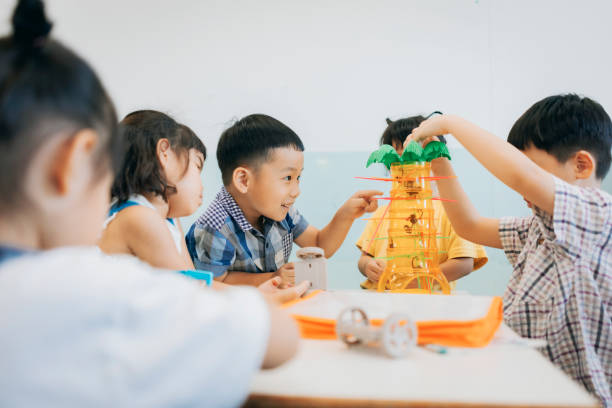
STEAM learning for preschool-age children looks nothing like a university engineering course. It looks like a child carefully pouring water between containers of different shapes and wondering why the tall thin one seems to hold more than the short wide one. It looks like a group of four-year-olds trying to build a bridge from blocks and sticks that will hold the weight of a toy car. It looks like a child mixing colours with paint and making predictions about what will happen when yellow meets blue. It looks like a class creating a mural together, negotiating composition and colour, and then describing what their artwork represents.
In each of these moments, the child is doing something profoundly STEAM-like: asking a question, making a prediction, testing an idea, observing what happens, revising their thinking, and communicating their findings. These are not just science skills or engineering skills — they are the fundamental habits of mind that successful thinkers in every field share.
Why Arts Belongs in STEAM
The inclusion of Arts in what was previously known as STEM is one of the most important developments in twenty-first century educational thinking. Creative and artistic thinking are not luxuries or extras — they are central to the kind of innovative, human-centred problem-solving that the modern world demands. The designer who makes technology accessible to elderly users, the architect who creates buildings that respond to local cultural context, the data scientist who finds a compelling way to visualise complex information: all are practising a form of thinking that integrates technical knowledge with creative sensibility.
For young children, the arts also provide the most accessible entry point into STEAM thinking. A child who has never consciously engaged with a science concept has been making art — drawing, painting, singing, dancing, building — since infancy. Using art as a bridge to science and mathematics thinking is an approach that builds on children’s existing confidence and joy rather than introducing entirely unfamiliar territory.
The Core STEAM Dispositions in Early Childhood
Curiosity and Questioning
The disposition most fundamental to STEAM thinking — and the one young children possess in the greatest abundance — is curiosity. The instinct to ask ‘why’, ‘what if’, and ‘what happens when’ is the engine of scientific and creative inquiry. Early childhood settings that encourage and celebrate children’s questions, rather than treating them as distractions, are building the most important foundation of all STEAM learning. The top nursery schools in Bangalore that make question-posing a central part of their daily culture — through wonder walls, open-ended provocations, and educators who respond to children’s questions with genuine interest rather than quick answers — are cultivating the most valuable STEAM disposition of all.
Experimentation and Tinkering
Young children are natural experimenters. They touch, taste, pour, stack, pull apart, and recombine with an empirical thoroughness that any scientist would recognise as genuine inquiry. STEAM-oriented early childhood settings harness this instinct by providing rich materials for tinkering — loose parts, building materials, water and sand, tools, natural objects — and the time and freedom to explore them without predetermined outcomes. The key message to children in these environments is that trying things, getting unexpected results, and trying again is not failure — it is exactly how learning works.
Collaboration and Communication
STEAM projects in professional settings are almost always collaborative. Scientists work in teams, engineers design together, artists collaborate on large-scale work. Introducing children to the pleasures and challenges of collaborative making — building something together, solving a problem as a group, communicating ideas to peers — builds the social and communicative dimensions of STEAM alongside the technical and creative ones.
Persistence and Growth Mindset
Perhaps the most important non-cognitive skill that STEAM learning builds is persistence — the capacity to keep trying when things do not work out as expected. For young children, experiencing that a design can be revised, a hypothesis tested again, a piece of art reworked, builds a growth mindset that will serve them across every domain of learning. Settings that celebrate the process of trying and improving rather than only the achievement of a finished product are teaching something more valuable than any specific STEAM concept.
How Preschools in Bangalore Are Introducing STEAM
Across Bangalore’s early childhood sector, there is growing recognition of the importance of STEAM-oriented learning in the preschool years. The best preschools in Bangalore are designing learning environments that include dedicated science exploration areas, maker spaces with open-ended construction materials, art studios with a wide range of media, technology tools used thoughtfully and in moderation, and garden spaces where children can explore natural science directly. These environments communicate to children that curiosity is welcome, that making and testing are valued, and that the boundaries between subjects are artificial.
For parents exploring pre schools in Bangalore with an eye to STEAM readiness, the most useful questions to ask are not about specific programmes or curricula but about culture: Does the school welcome children’s questions? Are there spaces and materials that invite open-ended exploration? Do educators observe and extend children’s self-directed investigations, or do they redirect children to predetermined activities? These cultural indicators predict a school’s commitment to genuine STEAM learning more reliably than any programme title.
The quality of daycare in Bangalore also has STEAM implications for very young children. Infants and toddlers who spend their days in environments rich with sensory experience — varied textures, colours, sounds, materials to manipulate — are building the sensory and cognitive foundations on which all later STEAM learning rests. Even at this very early stage, the richness of the environment and the responsiveness of the adults shape the curious, exploratory disposition that STEAM learning depends upon.
How Parents Can Nurture STEAM Thinking at Home
STEAM thinking does not begin or end at school. Parents who bring a STEAM spirit to everyday family life give their children enormously rich additional learning opportunities:
- Cooking together introduces chemistry, measurement, and sequencing in a context that is immediately meaningful and delicious
- Gardening connects children to biology, ecology, and the cycles of growth in a hands-on, sensory-rich way
- Building with whatever is available — cardboard boxes, recycled materials, sticks from the garden — develops engineering and spatial thinking
- Asking genuine questions together (‘I wonder why the sky turns orange at sunset?’) models the curiosity and intellectual openness that STEAM learning cultivates
- Visiting science museums, art galleries, nature reserves, and maker spaces exposes children to the real-world contexts in which STEAM disciplines come to life
The best preschools in Bangalore actively partner with parents in this way — sharing the learning happening in school and suggesting simple home extensions that reinforce and deepen it. When the STEAM spirit of exploration and questioning flows between home and school, children experience a unified and mutually reinforcing learning world.
FAQs
1. Is STEAM learning appropriate for very young children?
STEAM learning is not only appropriate for young children — it is ideally suited to them. The curiosity, love of sensory exploration, and natural experimentalism that characterise early childhood are the very dispositions that STEAM learning cultivates. The content and complexity scale to the child’s developmental stage, but the underlying thinking habits can be nurtured from the earliest years.
2. Does STEAM learning replace traditional early childhood activities?
No. STEAM learning in early childhood is integrated into the rich fabric of play, story, art, music, and outdoor exploration that characterises high-quality early childhood education. It is not a separate programme or a replacement for developmentally appropriate practice — it is a lens through which the natural activities of early childhood are viewed, designed, and enriched.
3. How do preschools balance STEAM with social and emotional learning?
The best early childhood STEAM experiences are inherently social and emotionally rich. Collaborative building projects, group science investigations, and shared art-making all require and develop empathy, communication, conflict resolution, and emotional regulation alongside the STEAM skills themselves. In high-quality settings, social-emotional and STEAM learning are not competing priorities — they reinforce each other continuously.
4. What should parents look for in a STEAM-oriented preschool in Bangalore?
Look for rich, varied materials for open-ended exploration; evidence that children’s questions are welcomed and extended; maker spaces or construction areas; art studios with a wide range of media; and educators who can articulate the learning intentions behind their environment design. The top nursery schools in Bangalore that are genuinely STEAM-oriented will be able to describe specific examples of investigations and projects that have emerged from children’s own curiosity.
5. How does early STEAM learning connect to future academic and career success?
The dispositions cultivated through early STEAM learning — curiosity, persistence, creative problem-solving, comfort with uncertainty, and the ability to collaborate and communicate across disciplines — are precisely the qualities that higher education and the future workforce most value. Children who develop these habits of mind in their early years carry a lasting advantage into every subsequent stage of their education and working lives.
